How Play-Based Learning Shapes Confident, Curious Learners
- 18 August 2025


At Oakridge International School, Gachibowli, we believe that children are natural learners. Their curiosity, imagination, and energy drive them to explore the world around them. That’s why our Early Years Programme is rooted in play-based learning, a powerful approach that nurtures confident, creative, and lifelong learners.
Play-based learning is more than just fun and games. It’s a thoughtfully designed educational approach where purposeful play leads to meaningful learning. Aligned with the IB PYP (Primary Years Programme) philosophy, it places student agency, inquiry, and exploration at the heart of the learning process.
Children are encouraged to ask questions, explore ideas, try new things, and reflect on their experience, all through play. This method supports early childhood education by making learning joyful, engaging, and deeply impactful.
In our classrooms, open-ended play activities are key. For example, during our Unit of Inquiry on “Who We Are,” children explored friendship through games, story read-alouds, and role-play. These activities helped them understand emotions and relationships while building confidence and self-expression.
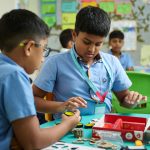
Whether it’s building with blocks, creating art with loose parts, or engaging in pretend play, children are constantly practicing communication, collaboration, and creativity. A child leading a group to build a bed for Goldilocks during a STEAM activity is not just playing, they’re learning leadership, problem-solving, and teamwork.
These STEAM-based play experiences also introduce concepts like measurement, stability, and design thinking, while enhancing language and social skills. They spark curiosity and help children make real-world connections in imaginative ways.
While play offers freedom, our learning goals are always intentional. We design play experiences that align with developmental milestones while allowing children to explore in their own way.
For instance, a math concept like patterning can be introduced through bead threading or block play. The learning objective is clear, but the path is open-ended, encouraging individual curiosity and creative problem-solving.
Our educators act as facilitators, gently guiding children’s thinking and helping them construct knowledge through inquiry-based learning.
Our learning spaces, both indoor and outdoor, are designed to provoke curiosity and inspire exploration. Every corner of the classroom tells a story or poses a question.
Outdoor learning is equally vital. We offer designated stations for fine motor and gross motor development, enhanced with natural and recycled materials like bottle caps, tissue rolls, shells, and stones. These loose parts invite children to build, sort, create, and solve problems.
Sometimes, our outdoor areas are transformed with Unit of Inquiry (UOI) resources, like themed trails or interactive displays, that extend learning beyond the classroom and deepen inquiry.
We regularly observe accelerated growth in social, emotional, cognitive, and physical development through play. Children learn to negotiate, share, empathize, and regulate emotions during cooperative play.
Cognitive skills grow as they solve puzzles or plan structures. Physical abilities strengthen through activities like threading, climbing, and balancing. It’s especially rewarding to see hesitant learners bloom into confident contributors when given the space to explore and express themselves.
We understand that play-based learning may be new for some families. That’s why we prioritize parent engagement through regular updates, classroom showcases, and Learning Celebrations.
Parents are invited to Curriculum Day events and Paraprofessional sessions, where they experience hands-on activities that mirror classroom learning. These sessions help families see how play supports conceptual understanding, skill development, and inquiry-based learning.
Many parents tell us, “We had no idea play could be this rich in learning.” And that’s the beauty of it, play is joyful, engaging, and deeply educational.
At Oakridge Gachibowli, we know that play is not a break from learning, it is learning. Through thoughtfully designed environments, intentional teaching, and a deep trust in children’s capabilities, we are nurturing the next generation of thinkers, doers, and leaders.
By embracing play-based learning, we’re shaping confident, curious learners who are ready to explore the world with wonder and purpose.